
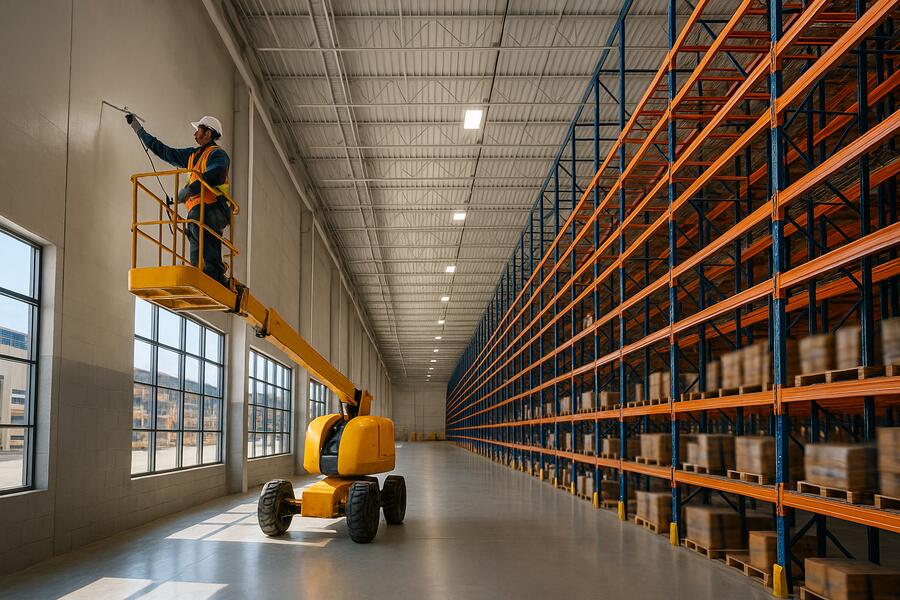
When planning an industrial painting project, such as a warehouse or manufacturing facility, you might be focused on the square footage of the walls and the type of coating needed. However, two often-underestimated factors can significantly impact the final cost of an industrial paint bid: ceiling height and the presence of racking systems. These elements introduce complexities related to safety, access, labor, and equipment, all of which directly influence the project’s overall expense. Understanding how ceiling height affects industrial paint bid pricing is crucial for accurate budgeting and project planning.
As professionals in industrial painting, we’ve encountered countless scenarios where these factors dramatically reshape a project. What might seem like a straightforward per-square-foot calculation for a standard office building becomes far more intricate in a high-bay warehouse. Let’s break down why ceiling height and racking play such a pivotal role in industrial painting bids.
industrial painting phoenix az
The Impact of Ceiling Height on Industrial Painting Costs
The higher the ceiling, the more complex and costly the painting project becomes. This isn’t just about covering more vertical space; it’s about the logistics of working at elevated heights.
Equipment and Access
- Specialized Lifts: Standard ladders and scaffolding are insufficient for high ceilings. Projects with ceiling heights ranging from 20 to 40 feet (or even higher) require specialized aerial lifts, such as scissor lifts, boom lifts, or rough terrain forklifts with man baskets. Renting and operating this equipment adds substantial cost.
- Operator Certification: Operating aerial lifts requires trained and certified personnel, adding to labor costs.
- Increased Setup/Breakdown Time: Moving and setting up large lift equipment takes considerably more time than traditional methods.
Safety Considerations
- Height Hazards: Working at significant heights inherently increases safety risks. This necessitates more stringent safety protocols, extensive fall protection measures, and additional safety equipment, all of which contribute to the overall bid.
- Safety Planning: Comprehensive safety plans, daily safety briefings, and designated safety personnel become more critical and add to the project overhead.
Labor and Application Efficiency
- Reduced Productivity: Workers on lifts operate at a slower pace compared to those working at ground level. Maneuvering lifts, securing positions, and repositioning take time, reducing the overall square footage that can be painted per hour.
- Application Method: High ceilings often necessitate spray application for efficiency, which requires extensive masking and protection for surrounding areas and equipment. While faster for coverage, the prep time is often much longer than traditional brush-and-roll.
- Fatigue: Sustained work at height can be more physically demanding, potentially impacting efficiency over long shifts.
For industrial painting phoenix az, where large warehouses and manufacturing plants are common, understanding these height-related costs is crucial for accurate estimates.
💡 Key Takeaway: Higher ceilings drive up industrial paint bids due to the need for specialized access equipment, increased safety measures, reduced labor efficiency, and extensive masking required for spray application.
How Racking Systems Influence the Paint Bid
Racking, common in warehouses and distribution centers, presents its own unique set of challenges that significantly affect painting costs.
Obstruction and Access Challenges
- Limited Workspace: Racking systems create a maze of obstructions, making it difficult to maneuver lifts and reach all wall surfaces. This forces painters into more confined and time-consuming positions.
- Reduced Speed: Navigating around racking is slow. Each column, crossbeam, and shelf requires careful maneuvering of equipment and often hand-painting in tight spaces, drastically reducing the efficiency of spray or roller application.
- Protection and Masking: Products stored on shelves, or the racking itself, may need to be masked off or covered extensively to protect them from overspray, adding significant labor and material costs.
Product and Inventory Management
- Inventory Relocation: If the racking is loaded with inventory, the cost might include coordination with the client to relocate products or work in phases around active operations. This can lead to non-standard working hours (nights, weekends), incurring premium labor rates.
- Dust and Debris: Dust and debris from preparation (sanding, cleaning) can contaminate products if not meticulously contained, requiring more intensive protection protocols.
Surface Complexity and Preparation
- Cleaning and Prep: Racking often accumulates dust, grime, and cobwebs. Cleaning and preparing the surfaces behind and around racking can be labor-intensive, requiring specialized tools and techniques.
- Specific Rack Painting: If the racking itself needs to be painted (e.g., for safety colors or corrosion protection), this is an entirely separate scope of work, requiring specialized coatings and detailed application.
💡 Key Takeaway: Racking systems increase paint bids by creating access obstructions, slowing down work, necessitating extensive protection for inventory, complicating surface preparation, and potentially requiring off-hours work for minimal disruption.
Beyond Height and Racking: Other Cost Drivers
While ceiling height and racking are major factors, several other elements also contribute to the complexity and cost of an industrial paint job.
Surface Condition and Type
- Existing Paint Condition: Peeling, chalking, or damaged existing paint requires extensive scraping, sanding, or power washing, adding significant prep time.
- Substrate Material: Painting over different materials (concrete, steel, drywall) requires specific primers and adhesion techniques. Bare metal, for example, needs specialized rust-inhibiting primers.
Type of Coating and Number of Coats
- Specialty Coatings: Industrial environments often require high-performance coatings, such as epoxies, urethanes, or chemical-resistant paints, which are more expensive per gallon and often more challenging to apply.
- Number of Coats: Each additional coat of paint increases material and labor costs.
Operational Constraints and Scheduling
- Operating Hours: Working around a facility’s operational hours (e.g., nights, weekends, shutdowns) almost always incurs higher labor costs due to overtime wages.
- Sectional Work: Phased painting to minimize disruption means more setup and breakdown time, reducing overall efficiency.
| Cost Factor | Impact on Bid | Reasoning |
|---|---|---|
| Ceiling Height | Significant Increase | Specialized lifts, enhanced safety, reduced efficiency, extensive masking. |
| Racking Systems | Moderate to Significant Increase | Obstructions, slow access, need for protection/masking, potential off-hours work. |
| Surface Condition | Variable Increase | More prep (scraping, cleaning, patching) if damaged or dirty. |
| Coating Type | Variable Increase | Specialty industrial coatings cost more and may require specific application expertise. |
| Operational Constraints | Potential Increase | Off-hours work (nights/weekends) or phased projects incur premium labor rates. |
💡 Key Takeaway: Beyond height and racking, other factors like current surface condition, the need for specialty coatings, and operational constraints (like working after hours) further contribute to the overall complexity and cost of an industrial painting project.
Understanding how ceiling height and racking affect an industrial paint bid is essential for any facility manager or business owner planning a painting project. These aren’t just minor details; they are fundamental elements that shape the entire scope, timeline, and cost. By anticipating these challenges and discussing them openly with your painting contractor, you can ensure a more accurate estimate, a smoother project execution, and a high-quality, durable finish that meets the demands of your industrial environment.
Have questions about how ceiling height and racking affect an industrial paint bid? Reach out to our team today.
Frequently Asked Questions
Does an open-deck ceiling (exposed joists, conduit, HVAC) cost more to paint than a smooth, finished ceiling?
Yes, an open-deck ceiling typically costs more to paint per square foot of floor area than a smooth, finished ceiling. While the “surface area” might be greater due to all the exposed structural elements, the primary cost driver is the labor-intensive nature of painting around all the ducts, pipes, conduits, and joists. This usually requires spray application and extensive masking, which adds to the overall complexity and time, even if the total paint volume isn’t drastically higher.
Is it more cost-effective to paint racking or replace it?
This depends on the condition of the racking and the desired outcome. If the racking is structurally sound but just needs a refresh, painting is almost always more cost-effective than replacement. Painting can provide corrosion protection and improve aesthetics. However, if the racking is severely damaged, rusted, or structurally compromised, replacement might be the safer and more economical long-term solution.
Can painting be done while the facility is operational?
Often, yes, but it comes with additional costs and complexities. Working in an operational facility requires meticulous planning, stringent safety measures (e.g., proper ventilation, dust containment, clear signage), and often involves phasing the project to minimize disruption to your business. This can include working after hours or on weekends, which typically incurs higher labor rates (overtime). The bid will reflect these added challenges and requirements.
What kind of coatings are recommended for high-traffic industrial floors?
For high-traffic industrial floors, epoxy or urethane floor coatings are highly recommended. These systems offer exceptional durability, abrasion resistance, chemical resistance, and are easy to clean. The specific type (e.g., 100% solids epoxy, urethane topcoats) will depend on the level of traffic, chemical exposure, and aesthetic requirements of your particular facility.
