
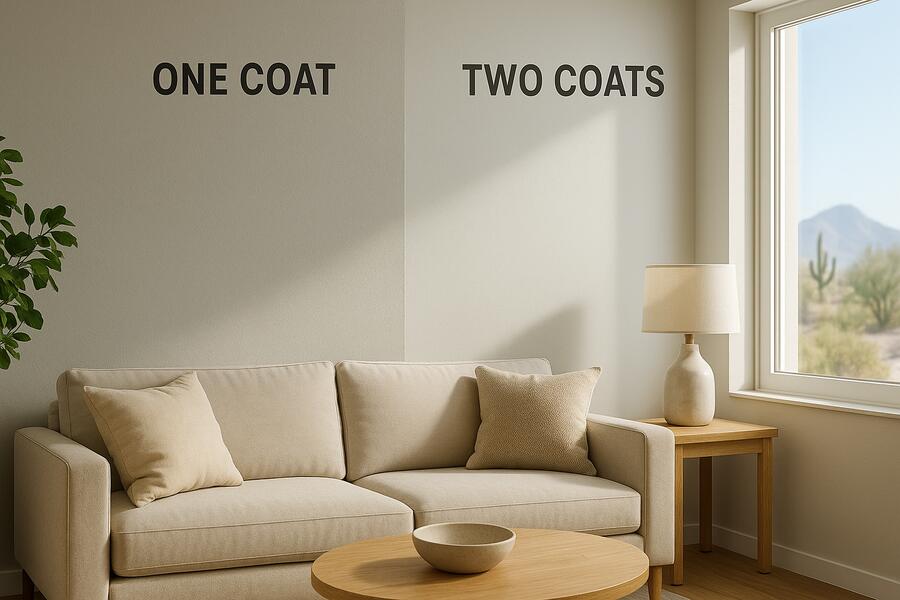
You’re standing in a freshly painted room, admiring the new color, but a question lingers: Is one coat enough, or does it need another? This is a common dilemma for anyone undertaking an interior painting project. While the idea of saving time and paint with a single coat is appealing, the reality is that a professional, durable, and aesthetically pleasing finish almost always requires more. Understanding how many coats of interior paint needed isn’t just about color coverage; it’s about achieving consistency, depth, and longevity for your walls.
As painting professionals, we’ve seen firsthand that cutting corners on coats often leads to a disappointing result. What might look “good enough” after one coat can reveal streaks, unevenness, and poor durability over time. Let’s break down the factors that determine the optimal number of coats for your interior painting project.
The Two-Coat Standard: Why It’s the Industry Norm
For most interior painting projects, two coats of paint are the industry standard for a reason. This isn’t just about using more paint; it’s about building a robust and beautiful finish.
Achieving True Color and Evenness
- Full Coverage: The first coat of paint provides the base layer, but it rarely achieves a perfectly uniform color, especially if you’re changing shades. It often looks slightly uneven, streaky, or shows remnants of the previous color.
- Color Accuracy: The second coat is crucial for revealing the paint’s true, intended color. Manufacturers formulate paints to achieve their advertised hue and depth with two coats.
- Eliminating Imperfections: Two coats help smooth out any minor application imperfections, roller marks, or brush strokes from the first coat, resulting in a much more consistent and professional finish.
Enhanced Durability and Washability
- Stronger Film: Two coats create a thicker, more durable paint film. This added thickness makes the surface more resistant to everyday wear and tear, scuffs, and impacts.
- Improved Washability: A robust two-coat finish is much more capable of withstanding cleaning and wiping without the paint being removed or damaged, which is particularly important in high-traffic areas or homes with children and pets.
💡 Key Takeaway: Two coats of interior paint are the industry standard because they ensure full, even color coverage, eliminate imperfections, and create a stronger, more durable, and washable finish that reveals the paint’s true hue.
When More Than Two Coats Might Be Needed
While two coats are generally the rule, there are specific scenarios where a third (or even a fourth) coat, or a primer, becomes essential.
Drastic Color Changes
- Going from Dark to Light: This is arguably the most common reason for needing more than two coats. A very dark color (like navy or deep red) being covered by a very light color (like white or pale gray) will often require a minimum of two topcoats over a dedicated primer, or sometimes three topcoats if no primer is used. The pigment in light paints struggles to completely obscure dark undertones in just two layers.
- Going from Light to Dark with a Strong Pigment: While less common than dark-to-light, some highly saturated dark colors (e.g., deep charcoal, vibrant teal) may benefit from three coats to achieve their full, rich depth, especially if they are covering a very light base.
New, Unpainted, or Heavily Repaired Surfaces
- New Drywall: Untreated drywall is highly porous and will absorb the first coat of paint unevenly. It absolutely requires a dedicated primer followed by two finish coats. The primer seals the surface and provides a uniform base for the topcoats.
- Heavily Patched Walls: If your walls have extensive patches and repairs, even if they’ve been previously painted, these areas can flash through (appear differently) after two coats. A primer applied specifically to the patched areas (or the whole wall) before two topcoats will help achieve a seamless finish.
- Glossy Surfaces: If painting over a high-gloss or semi-gloss finish, the surface needs to be properly scuff-sanded and primed to ensure adhesion, followed by two finish coats.
Paint Quality and Sheen
- Lower Quality Paint: Cheaper paints often have lower pigment concentration and less hiding power, meaning they will require more coats to achieve full coverage and color accuracy.
- Flat/Matte Finishes: While often good at hiding minor surface imperfections, flatter sheens sometimes have slightly less hiding power than higher-sheen paints and may occasionally need a third coat for perfect uniformity over a challenging base.
💡 Key Takeaway: Three or more coats, or a primer plus two coats, are typically needed for drastic color changes (especially dark-to-light), new drywall, heavily repaired surfaces, or when using lower-quality paints.
When One Coat Might Be Enough (Proceed with Caution)
While we generally recommend two coats, there are very limited scenarios where one coat *might* suffice. These are the exceptions, not the rule.
Rare Scenarios for One Coat
- Exact Color Match for Touch-Ups: If you’re simply doing a small touch-up on an existing wall with the exact same paint and sheen, one careful application might blend seamlessly. However, even then, differences in application technique or paint batch can be noticeable.
- Painting Same-Over-Same, Excellent Condition: If you are repainting a wall the exact same color, with the same brand and sheen, and the existing paint is in perfect condition (no fading, no stains, no repairs), one coat *could* potentially offer a refresh. However, this is a risk, and a second coat still offers superior durability.
Even in these cases, it’s wise to apply a second coat to ensure maximum durability and a truly even appearance. Professional interior painting phoenix az always defaults to a minimum of two coats for the best results.
| Surface/Situation | Recommended Coats (Primer + Paint) | Notes |
|---|---|---|
| Previously Painted Walls (Same Color) | 2 Coats Paint | Standard for refreshing. |
| Previously Painted Walls (Color Change, Light-to-Dark) | 2 Coats Paint | Darker colors hide well. |
| Previously Painted Walls (Color Change, Dark-to-Light) | 1 Coat Primer + 2 Coats Paint (or 3 Coats Paint) | Primer is highly recommended for best results. |
| New Drywall / Unpainted Surfaces | 1 Coat Primer + 2 Coats Paint | Primer is essential for sealing and adhesion. |
| Heavily Patched Walls | Spot Prime Patches + 2 Coats Paint | Ensures even finish over repairs. |
💡 Key Takeaway: While very specific touch-up scenarios might allow for one coat, for any significant painting project, relying on a single coat is a risk that almost always compromises the final appearance and durability.
Understanding how many coats of interior paint needed is crucial for a successful painting project. While two coats are the general standard for achieving true color, evenness, and durability, specific situations like drastic color changes, new drywall, or significant repairs will necessitate a primer and/or additional coats. Investing the time and effort into applying the correct number of coats ensures a professional-looking, long-lasting finish that you’ll be proud of for years to come. Always follow the paint manufacturer’s recommendations and don’t hesitate to consult with professionals for complex projects.
Have questions about how many coats interior paint actually needs? Reach out to our team today.
Frequently Asked Questions
What happens if I only apply one coat of paint when two are needed?
If you only apply one coat when more are needed, you’ll likely see uneven color, visible streaks, or blotchiness. The previous color might bleed through, and the paint film will be thinner, making it less durable and more susceptible to damage, scuffs, and difficult to clean effectively. The true richness and depth of your chosen color will not fully emerge.
How long should I wait between coats of paint?
The waiting time between coats is critical and should always follow the paint manufacturer’s instructions, typically found on the paint can label. For most latex/acrylic interior paints, this is usually 2 to 4 hours. For oil-based paints, it can be 24 hours. Applying a second coat too soon can lead to bubbling, peeling, or an uneven finish.
Do “paint and primer in one” products reduce the need for multiple coats?
“Paint and primer in one” products can be effective for minor color changes or painting over previously painted surfaces in good condition. They combine the properties of both but are not a substitute for a dedicated primer on new, unpainted drywall or when making drastic color changes (e.g., dark to light). Even with these products, two coats are almost always recommended for the finish coat to achieve optimal results.
Does the type of paint sheen affect how many coats are needed?
To some extent, yes. Generally, paints with a lower sheen (like flat or matte) might require a third coat more often than higher sheens to achieve perfect uniformity, especially over a challenging base, due to their slightly lower hiding power. However, for most standard situations, two coats are still the norm across all sheens. Higher-sheen paints, while durable, can also sometimes highlight imperfections more, making even application over two coats crucial.
