
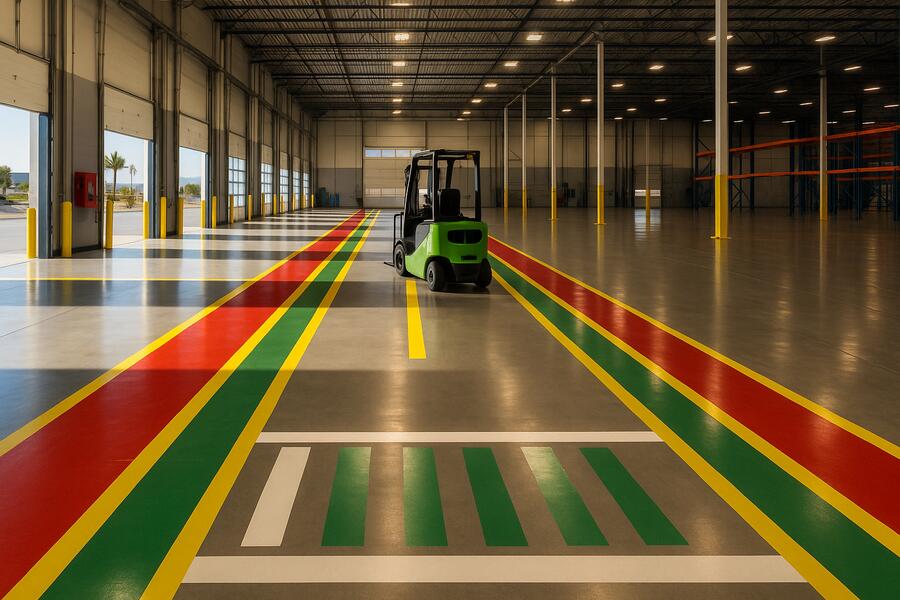
The Essentials of Effective Warehouse Floor Marking
In any industrial or commercial setting, particularly warehouses and manufacturing facilities, safety and operational efficiency are paramount. A critical component in achieving both is well-executed warehouse floor marking and safety striping. Far more than just painted lines, these visual cues create an organized, safe, and productive environment. They guide traffic, delineate hazardous zones, and ensure compliance with safety regulations, preventing accidents and streamlining workflows.
Effective floor marking involves a strategic approach to design, material selection, and adherence to established guidelines. While OSHA (Occupational Safety and Health Administration) mandates that permanent aisles and passageways be “appropriately marked,” it also provides guidance on color-coding for specific hazards, underscoring the importance of clear visual communication. Understanding how these systems work is crucial for property managers and business owners looking to enhance safety and operational flow.
💡 Key Takeaway: Strategic warehouse floor marking is essential for guiding traffic, defining safety zones, preventing accidents, and optimizing operational efficiency in industrial environments.
OSHA Requirements and Safety Color Codes
OSHA Standard 29 CFR 1910.176(a) clearly states that “permanent aisles and passageways shall be appropriately marked.” While this standard requires marking, OSHA 29 CFR 1910.144 further specifies safety color codes for certain hazards, primarily red and yellow, which have become industry standards for floor marking.
- Yellow: This is the most common color for general caution and for marking physical hazards that could result in striking, tripping, falling, or caught-between injuries. Yellow is universally used to define traffic lanes, forklift aisles, pedestrian walkways, and work cell boundaries.
- Red: Red is designated for “Danger” and for marking areas related to fire protection. This includes locations for fire extinguishers, fire lanes, emergency stops, and around electrical panels to indicate required clearance (often 36 inches).
While OSHA formally mandates only red and yellow for specific hazards, other colors have become widely accepted best practices, often adopted from ANSI (American National Standards Institute) guidelines or 5S methodology to enhance visual communication. These additional colors help create a more intuitive and comprehensive safety system, which is a key component of effective industrial painting phoenix az services.
Common Floor Marking Colors and Their Applications
Beyond the OSHA-mandated colors, a broader palette is used to convey specific information and hazards within a warehouse:
- Blue: Typically indicates mandatory PPE (Personal Protective Equipment) areas, marking equipment that is out of order, or to designate raw materials.
- Green: Used for safety equipment locations (excluding fire equipment), first-aid stations, and safe pedestrian pathways.
- Orange: Denotes “Warning,” often used for equipment under repair or areas with moderate hazards.
- White: Commonly used for general housekeeping, marking equipment storage areas, and defining non-critical pathways.
- Black: Often used with yellow or white for general housekeeping, finished goods, or to create a sharp contrast for defining areas.
- Black/Yellow Stripes: These highly visible striped lines are used to mark hazard zones, physical obstructions, or areas requiring extra caution.
- Red/White Stripes: Used for fire equipment zones, emergency keep-clear areas, or temporary danger zones.
💡 Key Takeaway: While OSHA specifies red and yellow for hazards, a broader spectrum of colors (blue, green, orange, white, black) is used in best practices to communicate specific safety and operational information on warehouse floors.
Aisle Widths and Line Thickness Standards
Beyond color, the physical dimensions of floor markings are also crucial for visibility and compliance:
- Aisle Widths: OSHA guidelines suggest that aisles should be at least 3 feet wider than the largest equipment used, or a minimum of 4 feet, to ensure safe passage for both vehicles and pedestrians. The goal is to prevent collisions and ensure clear movement.
- Line Thickness: For visibility, lines should typically be a minimum of 2 inches wide, with a recommendation for 2-6 inches. Main traffic lanes and aisle paths often use wider lines (4-6 inches) to enhance visibility, especially in busy environments.
These dimensions help ensure that markings are easily seen by operators of forklifts and other industrial vehicles, as well as by pedestrians, even from a distance or in varying light conditions.
Materials and Application for Longevity
The durability of floor markings depends heavily on the materials used and the application process. Given the heavy traffic, abrasion, and potential for chemical spills in warehouses, specialized paints and coatings are essential.
- Epoxy and Polyurea Coatings: These two-component systems are highly recommended for main traffic lanes due to their exceptional durability, chemical resistance, and adhesion. They are applied at thicknesses ranging from 20-40 mils and cure to a hard, long-lasting finish that can withstand heavy forklift traffic and resist chipping.
- Acrylic and Alkyd Paints: While less durable than epoxies, heavy-duty acrylic and alkyd traffic paints can be suitable for lighter traffic areas or for temporary markings. They offer good adhesion and quick drying times but may require more frequent reapplication.
- Surface Preparation: Proper surface preparation is paramount. This typically involves thorough cleaning, degreasing, and sometimes grinding or shot blasting the concrete to ensure optimal adhesion of the paint or coating. Without adequate prep, even the best materials will fail prematurely.
💡 Key Takeaway: For long-lasting and effective floor marking, durable materials like two-component epoxy or polyurea coatings are essential, coupled with meticulous surface preparation to ensure proper adhesion and resistance to heavy industrial wear.
Implementation Best Practices for Warehouse Floor Marking
Beyond technical specifications, successful warehouse floor marking relies on strategic implementation:
- Facility Assessment: Begin with a thorough assessment of traffic patterns (pedestrian, forklift, vehicle), storage areas, hazard zones, and emergency exits. This informs the layout and color scheme.
- Clear Planning: Develop a detailed floor plan that maps out all markings, including colors, widths, and specific meanings.
- Phased Application: For active warehouses, work can be phased to minimize disruption, perhaps by sectioning off areas or working during off-hours.
- Regular Maintenance: Floor markings are subject to wear. Regular inspections and touch-ups or reapplication are necessary to maintain visibility and compliance.
- Employee Training: Ensure all employees understand the meaning of each color and marking. This reinforces the safety system and promotes a culture of awareness.
| Color | OSHA/ANSI Significance | Common Applications |
|---|---|---|
| Yellow | Caution, Physical Hazards (striking, tripping) | Aisles, traffic lanes, pedestrian walkways, work cells, forklift paths |
| Red | Danger, Fire Protection Equipment | Fire extinguisher zones, emergency stop buttons, electrical panel clearance |
| Blue | Mandatory PPE, Out-of-Order Equipment | Areas requiring safety glasses/hard hats, equipment under repair, raw materials |
| Green | Safety Equipment, First-Aid, Safe Passageways | Emergency exits, safe pedestrian routes, first aid kits, eye wash stations |
| Black/Yellow Stripes | Hazard Zones, Physical Obstructions | Areas with potential for crushing, falling objects, or low clearances |
Conclusion
Effective warehouse floor marking and safety striping are more than just a regulatory checkbox; they are a fundamental investment in the safety, efficiency, and productivity of any industrial facility. By adhering to OSHA guidelines, utilizing appropriate color codes, maintaining correct line dimensions, and employing durable materials, businesses can create a highly organized and visually intuitive environment that minimizes risks and optimizes operational flow. A well-planned and executed floor marking system is a clear sign of a commitment to safety and operational excellence.
Have questions about how to optimize your warehouse floor marking for safety and efficiency? Reach out to our team today.
Frequently Asked Questions About Warehouse Floor Marking
Are floor marking “standards” mandated by OSHA?
OSHA (29 CFR 1910.176(a)) mandates that permanent aisles and passageways be “appropriately marked.” While it doesn’t explicitly detail every color or line width for all scenarios, OSHA 1910.144 does specify red for danger/fire and yellow for physical hazards. Other colors are often adopted from ANSI guidelines or industry best practices for comprehensive safety.
What is the recommended width for aisle striping?
OSHA suggests that aisles should be at least 3 feet wider than the largest equipment used, or a minimum of 4 feet. For the striping itself, lines should be a minimum of 2 inches wide, with 2-6 inches being common for visibility, especially in high-traffic areas.
What kind of paint is best for warehouse floor marking?
For maximum durability and resistance to heavy traffic, chemicals, and abrasion, two-component epoxy or polyurea coatings are highly recommended. These provide a long-lasting finish. Heavy-duty acrylic or alkyd traffic paints can be used for lighter traffic areas or temporary markings.
How often should warehouse floor markings be refreshed?
The frequency depends on traffic volume, the type of coating used, and the overall wear and tear. High-traffic areas might need refreshing annually, while lighter traffic areas could last several years. Regular inspections are key to determining when lines start to fade or chip and require maintenance to maintain clear visibility and compliance.
